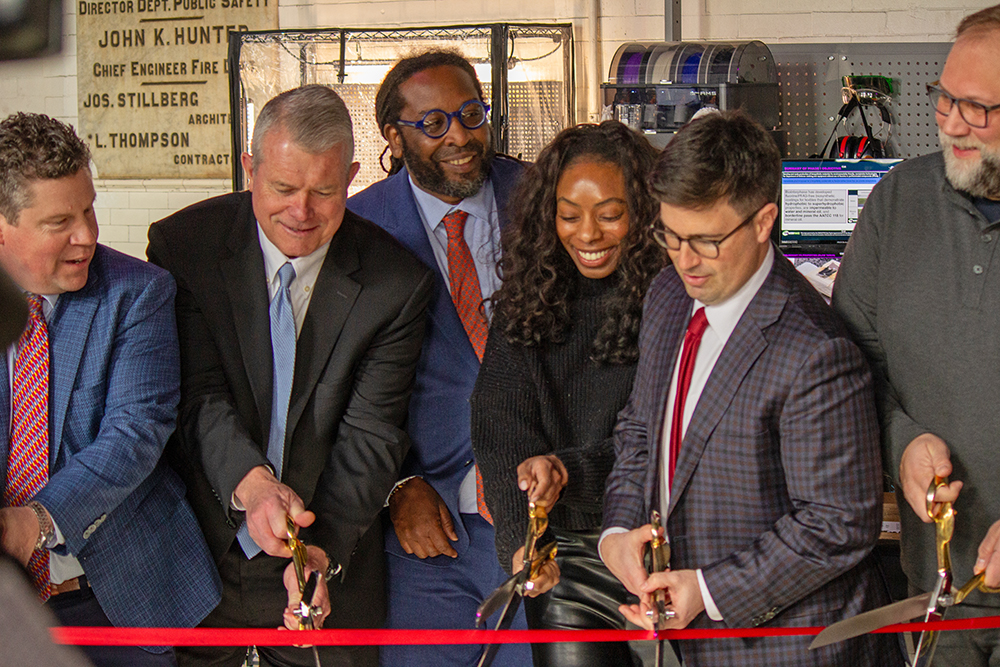
Historic Troy Hill Fire House Redeveloped Through Public‑Private Partnership
Pittsburgh, PA – The historic Troy Hill Fire House at 1800 Ley Street has been successfully redeveloped and returned to productive use through a public‑private partnership between QGE Holdings, the Urban Redevelopment Authority of Pittsburgh (URA), and the City of Pittsburgh.
QGE Holdings, a Wildman Chalmers sister company, served as Master Developer for the project, leading acquisition, financing, and redevelopment efforts. Wildman Chalmers, a Pittsburgh‑based architecture and design firm, served as Architect, guiding the building’s adaptive reuse while preserving its historic character.
Vacant for more than a decade, the former fire house has been adaptively reused as commercial office and laboratory space. The redevelopment includes restoration of historic masonry and windows, repair of original architectural elements, and targeted upgrades to building systems to meet current code, accessibility, and life‑safety requirements.
“This project to renovate a historic city-owned building that sat vacant for years into a commercial and laboratory space is the spirit of Main & Main,” said Mayor Corey O’Connor. “It’s about collaboration in working towards a shared goal of community vibrancy. This new era for the fire house will bring new jobs, new research, and new opportunities to the heart of the Troy Hill business district. Thank you to QGE Holdings, Wildman Chalmers and the URA for their hard work on this project."
The project was enabled through the URA’s public‑to‑private disposition process and approved by the URA Board of Directors, allowing a long‑idle publicly owned asset to transition back into private ownership, return to the tax rolls, and once again serve as a neighborhood anchor in Troy Hill.
“This project reflects the URA’s commitment to preserving important community assets and putting vacant properties back into beneficial reuse and onto our tax rolls,” said URA Executive Director Susheela Nemani-Stanger. “By conveying the historic Fire House for redevelopment, we were able to honor its legacy while creating new opportunities for innovation, investment, and economic growth. We’re proud to partner with the City of Pittsburgh and QGE Holdings to ensure this landmark continues to serve the Troy Hill community for generations to come.”
The restored fire house is now home to BioInterphase, a Pittsburgh‑based bioengineering firm, which occupies approximately 2,200 square feet of office and laboratory space. The company relocated to the facility, bringing new economic activity and employment opportunities to the Troy Hill neighborhood.
“This project demonstrates the power of thoughtful public‑private partnership,” said the development team. “Through close collaboration with the URA and the City of Pittsburgh, we were able to preserve a historically significant building while adapting it for contemporary use that supports neighborhood investment and long‑term vitality.”
Originally constructed in the late 19th century, the Troy Hill Fire House is one of the neighborhood’s most recognizable historic structures. Its redevelopment reflects a shared commitment by public agencies and private partners to preservation‑driven development that strengthens Pittsburgh neighborhoods.
###
Language translation is available free of charge. Please email translation@ura.org.
More News
Celebrating Downtown Revitalization Progress with Beacon Communities
More Than $6.9 million in LSA Grants Awarded to Support Pittsburgh Community Projects
